Monopoly : Star Wars Heroes vs Villains
Fast Facts
Monopoly : Star Wars Heroes vs Villains
Developer: Behaviour Interactive
Publisher: Ubisoft
Website: Monopoly : Star Wars Heroes vs Villains
Genre(s): Board Game, Strategy
Platform: Nintendo Switch 1/2, PlayStation 5, Windows, Xbox Series X/S
Age Rating: 7
Release Date: June 30th 2026
Price: £21.99 > £29.99
A code was provided for review purposes.
Is this actually Monopoly?
No. The quickest way to understand what this game is, is to completely remove its connection to Monopoly.
That’s not to dismiss Monopoly Star Wars, there are some positives in this game that will endear some younger audiences and those who are fans of both genres, especially a more strategy based vibe.
It’s also not just basic Star Wars Monopoly. I think everyone expected some form of reskin and actually were pleasantly surprised by the polished redesign and mechanics. The cinematic clips and quality voice work are enjoyable, for example Anthony Daniels as C-3PO, Ashley Eckstein as Ahsoka Tano and Sam Witwer as Emperor Palpatine and Darth Maul make these iconic characters feel recognisable and nostalgic.
Characters and their abilities genuinely matter and can provide some game-changing bonuses. So encouraging team composition, is better over aesthetic choices. With that, having teams of 2v2 or 3v3 really does give you a reason to cooperate.
Games though are extremely fast, more so than traditional Monopoly. Most games I’ve played have lasted 20-45 minutes, a lot quicker than regular Monopoly. You can adjust the games win requirements pre-start, but in my first game with my kids, of a 3v3, the AI rolled doubles each turn, and ended the game rather quickly. They were not impressed.
A Party Game in Monopoly Clothes
This game is different. It shares some characteristics of Monopoly, but also many things original board game players may miss.
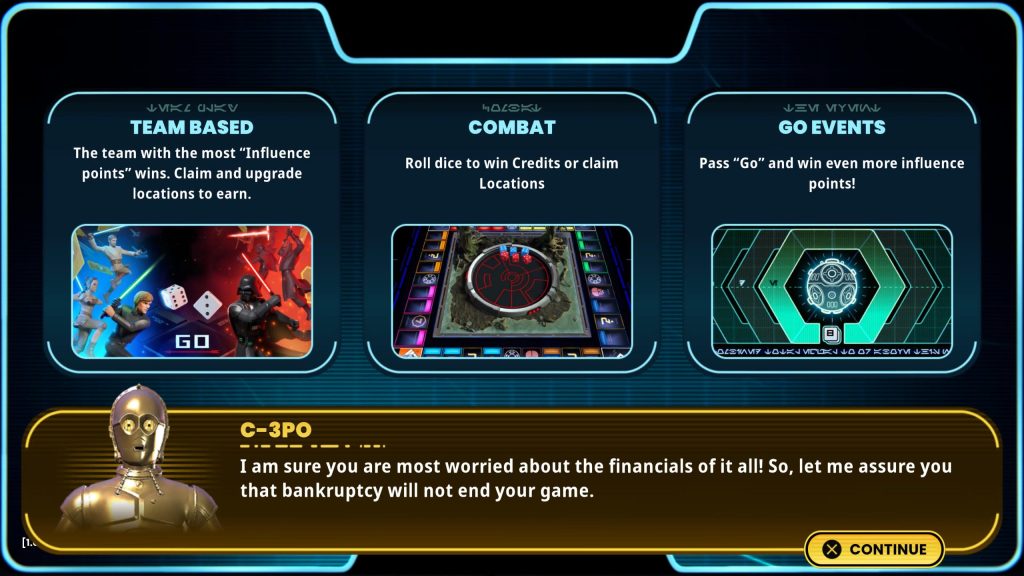
Negotiating Trades doesn’t exist, Bankruptcy barely matters, property ownership isn’t the primary objective and winning revolves around objectives, influence and “Go” events, rather than economic dominance.
There are 28 characters in total, 14 heroes and 14 villains, some of which you unlock through progression. Including cosmetics, like dice, ships and character skins.
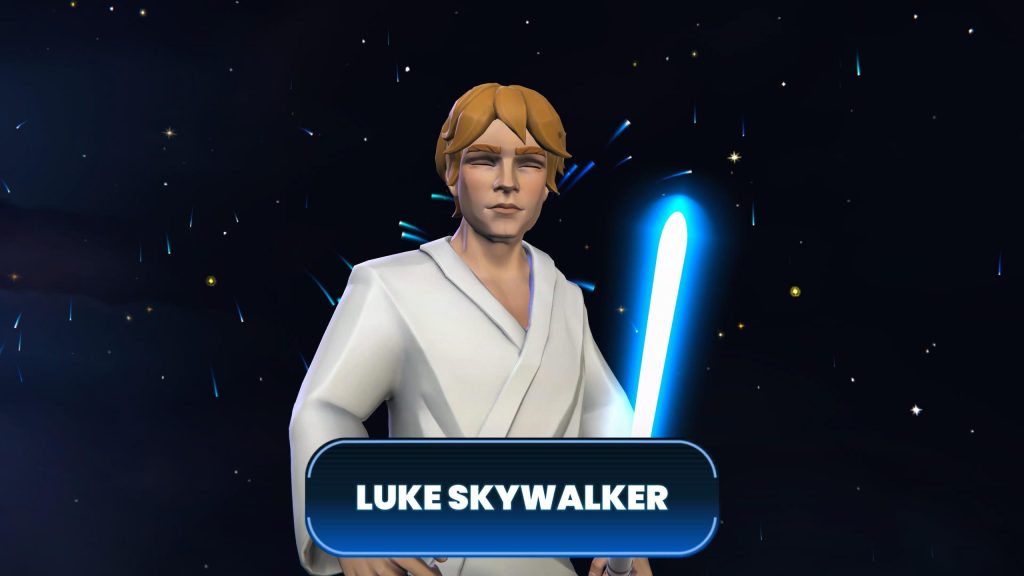
Characters genuinely matter. With each character having a mirrored ability to someone on the opposite side, reflecting Star Wars’ recurring theme of balance in the force. Leia Organa & Cad Bane steal credits when passing an opponent. Luke Skywalker and Darth Vader can call in allies to affect locations and grab neutral properties for fewer credits. These character abilities drives a welcome layer of strategy into each match and encourage you to think somewhat over just rolling some dice.
Depending on your team you can gain advantages like Mace Windu’s additional dice during combat, Dedra Meero has the ability to cut location claim costs by 50%, offering early strategic location acquisition. Where others can force combat randomly to win credits on demand. Working together really benefits the gameplay and its outcome, however they don’t completely overcome the influence of the dice.
Replay-ability
What encourages another game? Each character has a different ability, like I’ve stated so pairing Luke and Leia, will feel different to Vader and Kylo, so there’s some experimenting with synergies, to discover combinations that suit different play styles. However once you’ve played a few rounds, there really isn’t much progression beyond your own level of curiosity. The game doesn’t evolve over time and therefore offers little for long-term mastery.
The social unpredictability is really where this game has value. Just like tabletop Monopoly, people govern the replay value.
One match may have everyone targeting a specific character, others could be risky plays sparked from emotional decisions of loss. Player interaction is really the winning formula here and I’d argue the better way to play than against the AI.
The Star Wars branding is very heavy here, and the as mentioned the visual and audio elements are very well done. So simply enjoying the Star Wars universe could also keep you coming back. The enthusiasts are clearly the target audience. Players without the emotional and nostalgic attachment, may find the novelty wears off quickly.
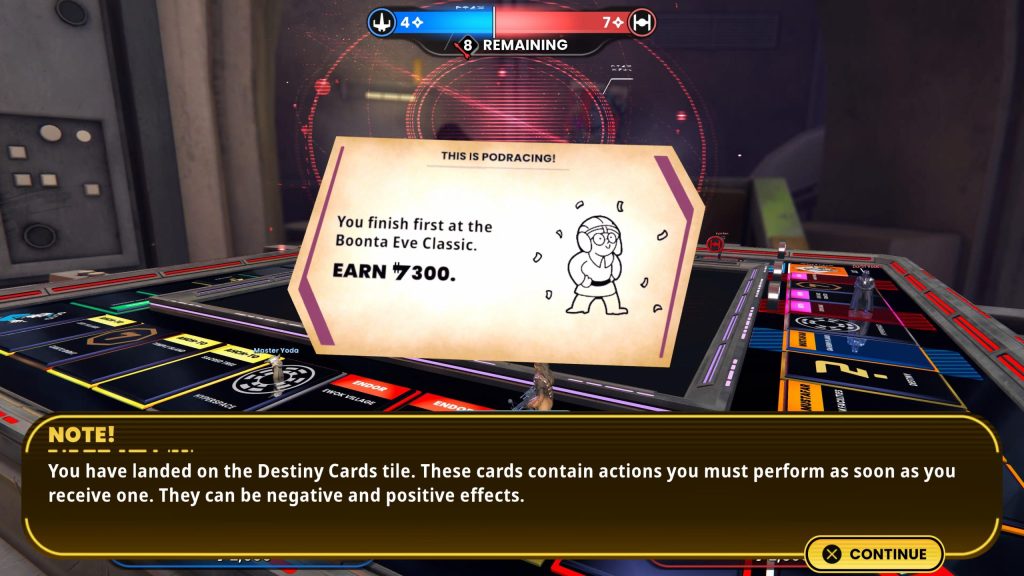
However, whilst character abilities and positioning matter, the dice remain the biggest driver of success and decisions can feel secondary to luck.
A game can swing dramatically because of an unfortunate roll, exciting in moderation, but frustrating when frequent. Choices seem to carry less weight than chance.
I’d have liked to see ever-shifting alliances, dynamic board functions altering based on planetary conditions, priorities changing based on events and mini-games… a more risk vs reward decision based game.
Does the Star Wars license matter?
In some ways no. This game could be reskinned into any popular IP. Marvel, Disney even Pokémon. This premise would work on the same rules, with their locations and “powers” because it’s not actually Monopoly as we know it.
However those are also what make this Monopoly game different. The licensing really adds the element of fandom outside of regular Monopoly and I’d argue that’s what drives people to buy the different Monopoly board games too. I read there’s over 1000 variations of the board game!
So what is this then? I’d say this is a party game wearing Monopoly’s clothes at a Star Wars convention.
What is great is you don’t need to enjoy Star Wars to play this version of Monopoly. It’s simple to learn for children and adults alike, and you could play with your grandparents as the game is very simple and the mechanics aren’t difficult to learn. On another less talked about note, the PlayStation version offers some accessibility options like large text and high contrast visuals, these can definitely support those who need it, and it’s good to see those options available.

Trust in the Force
Since having Monopoly: Star Wars Heroes vs Villains, I have played some local games with friends and each time we finished, they were keen to find something else to play. Monopoly: Star Wars Heroes vs Villains offers variety in its cast of characters and the unpredictability of human opponents and dice rolls. However it struggles to generate meaningful long-term replay-ability. Too much of each match hinges on the roll of the dice, while GO events can alter the course of play in a significant way. As a result, each game feels different in outcome, but not necessarily in experience. It’s enjoyable to revisit with friends on occasion, yet it lacks evolving systems and gameplay, that would bring strategic depth to encourage continuous play.
Star Wars Heroes vs Villains is a polished and accessible party game that happens to wear the Monopoly badge, but players expecting the strategic rise-and-fall of the classic Monopoly board game, may find it lacking.
As a lifelong Star Wars fan, I was excited for this Monopoly edition. For me though, it miscalculated the jump and just quite doesn’t hold the high ground.

Rapid Reviews Rating

3 out of 5
3
You can find and read our reviews on OpenCritic.